
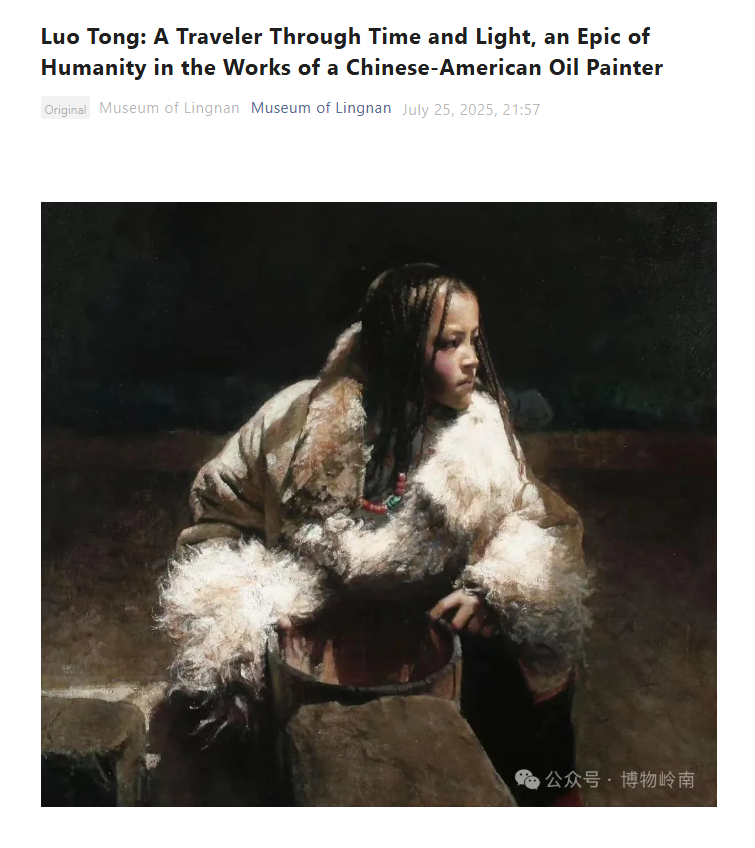
“Morning light streamed through the glass of Long Island, New York, flowing across easels piled high with paint tubes. Luo Tong gazed at an unfinished portrait of a Tibetan woman before him, his brushstrokes dancing across the rough canvas —the fourth portrait of the same family. From the girl's clear eyes to the fine lines at the corners of her mother's eyes, time was materialized into layers of texture under his palette knife. This oil painter, a graduate of the Guangzhou Academy of Fine Arts, has spent thirty years weaving a visual epic that transcends geographical boundaries, shuttling between his New York studio and the Tibetan plateau.”
Artistic roots across the ocean
Luo Tong 's artistic lineage is deeply rooted in the fertile soil of Chinese academic art. In 1986, he and the author were both admitted to the Affiliated High School of Guangzhou Academy of Fine Arts, becoming the only two scholars in their class to be directly admitted to university: one embarked on the artistic journey of traditional Chinese painting, while the other plunged into the colorful ocean of oil painting. In the postgraduate program of the Oil Painting Department at Guangzhou Academy of Fine Arts , Luo Tong studied under Professor Xie Chuyu . This rigorous training laid a solid foundation in form and a keen perception of color for him. After graduation, he stayed on to teach at the academy, but always yearned for a broader artistic dialogue, eventually traveling across the ocean to New York via Canada.
His early years in a foreign land were filled with struggle. Living in a cramped apartment, he worked odd jobs at a supermarket during the day and painted his dreams on canvas at night. The turning point came when Luo Tong's oil painting won first prize at an international salon and was discovered by the Green Gallery —an institution that values cultural diversity and keenly recognized the wonderful fusion of Eastern freehand style and Western expressionism in Luo Tong's work. Today, a 60 x 60 cm oil painting of his can fetch up to $ 80,000 in the European and American markets , making him one of the few Chinese artists to establish a foothold in the mainstream Western art market.
Tibet: An Artistic Pilgrimage that Travels Through Time
For Luo Tong , Tibet is not merely a subject matter, but a sanctuary for his soul. In the late 1990s , he first set foot on the plateau, encountering a five-year-old Tibetan girl named Zhuoma with star-like eyes in a temple on the border of Tibet and Qinghai . This moment initiated a gaze spanning thirty years: from the lively and agile nature of children, to the shy adolescence of girls, to the resilience and tolerance in marriage, and finally to the warm and loving embrace of an infant. Luo Tong 's brushstrokes trace the trajectory of life blossoming amidst the wind and frost of the plateau. This creative approach is reminiscent of the grand narrative of Li Bo'an's "Walking Out of Bayan Har," but Luo Tong chooses to capture the secrets of a farming family's life with a microscope-like focus.
“His canvases are containers of time,” commented the Green House Gallery curator . “While Western portraiture seeks the explosive power of a moment, Rothon reveals the thickness of time —each layer of paint is a sedimentary rock of years.”
In terms of technique, Luo Tong developed a unique "texture of time" language: his early portraits captured the luster of young girls' skin with fluid brushstrokes; in his middle age, he used thick paint to sculpt the creases of the face, even incorporating barley grains and prayer flag fragments into the paint to give the images a tactile realism. This devout record of life's journey makes his "Tibet Series" an important chapter in contemporary humanistic imagery.
Aesthetic Reconstruction Through East-West Convergence
In Luo Tong 's New York studio, reproductions of album leaves by Balthus and Bada Shanren hang on the walls . This juxtaposition hints at the core theme of his art: bridging the gap between the precise forms of classical figuration and the freehand philosophy of ink painting. The sleeves of the Tibetan women's robes in his paintings often utilize Cézanne-esque blocks of color to construct volume, while the folds and creases flow with the rhythm of calligraphic brushstrokes. At the 2023 New York Asia Week, his work was described by art critics as " a silent resonance between Eastern Zen and Neoclassical Symbolism ."
A deeper cultural integration is manifested on the spiritual level. While Western artists often symbolize Tibet as a mystical totem, Luo Tong, with the uniquely gentle gaze of Lingnan, deeply embeds his vision in the very fabric of this land . The butter lamps in his paintings not only symbolize faith but also reflect the exchanged glances among family members during late-night conversations; the fluttering prayer flags are not only a harmony between the wind and scriptures but also an invisible bond tied by a mother for her children traveling far away. This demystified and simple perspective elevates his narrative of Tibet beyond exotic wonders, transforming it into a universal poem of kinship.
Cultural nostalgia of the displaced
In Luo Tong 's creative process , a confluence of two kinds of nostalgia surges forth. In 2022, he revisited the Guangzhou Academy of Fine Arts and used WeChat to livestream to his students in New York about the falling kapok fluff: "Look, this is the snow of Lingnan." Such imagery often quietly seeps into his paintings— the butter tea bowl in the hands of an old Tibetan woman vaguely reflects the patterns of Cantonese porcelain ; the vermilion red of the shepherdess's dress echoes the bright sunset color of Princess Changping's phoenix robe in the Cantonese opera "The Princess Changping".
This implicit expression of cultural genes is particularly precious in overseas creations. His success confirms a new path for Chinese artists in the international context: neither catering to the rigid expectations of "Orientalism" nor severing ties with the bloodline of their mother culture, but as critics have said, reactivating the innovative spirit of the Lingnan School of painting—like Gao Jianfu's ambition to "compromise between Chinese and Western art"—in the contemporary context of globalization.
In the Long Island studio bathed in morning light, a video call screen lights up —Zhuoma appears before the camera, holding her newborn, the highland sunlight dancing on her smiling face. On Luo Tong's palette, ochre and titanium white begin to mix, a new layer of time about to cover the canvas. In this age of image overload, this stubborn painter combats oblivion with a slow, deliberate gaze, allowing each stroke of paint to settle into the amber of life.
As the exhibition lights at INTAGRAM Gallery illuminated one by one, viewers paused before "Zhuoma at Thirty ": the starlight in the woman's eyes had not faded, but had simply merged into the vast Milky Way. This beam of light originated from a studio by the Pearl River, traversed the steel jungle of New York, and finally found its home under the Tibetan sky —all great journeys are ultimately for reaching that shared spiritual plateau deep within the human heart.